Victim of unsolved Seattle CHOP killing featured in newly unearthed video


A newly unearthed video has revealed what is likely the last known footage of Antonio Mays Jr. speaking at 2020’s Capitol Hill Occupied Protest just days before his death.
The discovery comes on the eve of a civil trial that, with Mays’ killing still unsolved after more than five years, could be the only public airing of the homicide that led to the end of CHOP.
In the video, the 16-year-old stands next to protest leader David Lewis, who is addressing a city employee and a crowd of onlookers in the late days of Seattle’s CHOP zone. Mays gently taps Lewis on the shoulder and indicates he’d like to speak.
“The police, their purpose is to serve and protect, and we agree with their purpose, but we do not agree with them because of what they’ve been doing,” the teenager says to nods and murmurs of approval from the adults and protest organizers around him. “They have not been serving and protecting.
“We don’t really need someone telling us what needs to be done, because we’re smart,” he continues. “We can tell ourselves what needs to be done.” Protesters start to applaud. For a few moments, this 16-year-old is speaking for them.
Sponsored
In the video above by Converge Media founder Omari Salisbury, Antonio Mays Jr. appears at the 1:11:30 mark. The video was shot on June 26, 2020.
For years, Mays’ only week in Seattle after he left his home in Southern California to come to CHOP has remained a mystery. In the immediate aftermath of his death, protesters said in video interviews and on social media that self-appointed security volunteers, who had been worried for weeks about a vehicular attack or mass shooting, killed Mays to protect residents of CHOP occupying the blocks around the police department’s East Precinct. Mays’ death, which occurred 10 days after teenager Lorenzo Anderson was killed in the zone, was the final event to push the city to shut down the occupation.
Much of what protesters have repeated for years about Mays’ motivations has flowed from what was long assumed to be fact: that gunfire was coming from the white Jeep Mays was riding in the night he was killed. That account was reported by some protesters livestreaming during the chaotic events leading up to the fatal shooting.
But a video montage recently filed by the city as evidence in the civil trial scheduled to begin next week appears to contradict that narrative, as The Seattle Times and KUOW have previously reported. Now, the newly discovered video of Mays speaking on June 26, 2020, sheds light on two key questions that may come up at trial: who Mays was and what he was doing at CHOP.
The trial stems from a lawsuit filed by Mays’ father, who seeks unspecified damages. His lawsuit blames the city of Seattle for allowing CHOP’s existence and says the city botched the emergency response after his son’s shooting. Part of the city’s defense is its claim that the teenager was committing a felony — stealing a car and shooting — when he was killed. A review by The Seattle Times and KUOW of publicly available evidence, including the video montage commissioned by the city, failed to uncover footage of any gunfire coming from the white Jeep that Mays was riding in.
Sponsored

The video of Mays speaking before a crowd was livestreamed by Converge Media founder Omari Salisbury in 2020 and posted to YouTube at the time, where it sat undiscovered for years among the hundreds of hours of footage. The discovery of Antonio Mays Jr.’s appearance in the video was made by an NPR producer working on a project about CHOP by The Seattle Times, KUOW and NPR’s Embedded.
Mays’ death led Seattle’s mayor to order the end of CHOP, which city employees dismantled two days later. In the five years since, no charges have been filed in the shooting, and police say the case is still “open and active.” Because of the case’s designation as an open homicide investigation, the department has declined to provide reporters with more information or records related to the case.
Antonio Mays Sr. watched part of the video on a Zoom call with reporters from The Seattle Times and KUOW this week and confirmed it was his son on Salisbury’s livestream. “Is that my boy?” Mays Sr. said as his son appeared on screen, then burst into tears.
Mays Sr. said that, of all the options available to a 16-year-old in CHOP, his son had chosen to stand among protest leaders negotiating with city officials. “A zone full of chaos and anarchy, and that’s how he resurfaces: with the intellectuals,” Mays Sr. said. “He resurfaced with the intellectuals, with the peaceful protesters taking a stand, and voiced his opinion.
Sponsored
“For the city to be trying to slander his character and tear his character down the way that they’ve been doing is really disheartening to me,” he continued, referring to the city’s claim that his son was committing a felony at the time he was killed.
Salisbury, who captured the footage of Mays, expressed shock when reporters told him they had identified Mays in it.
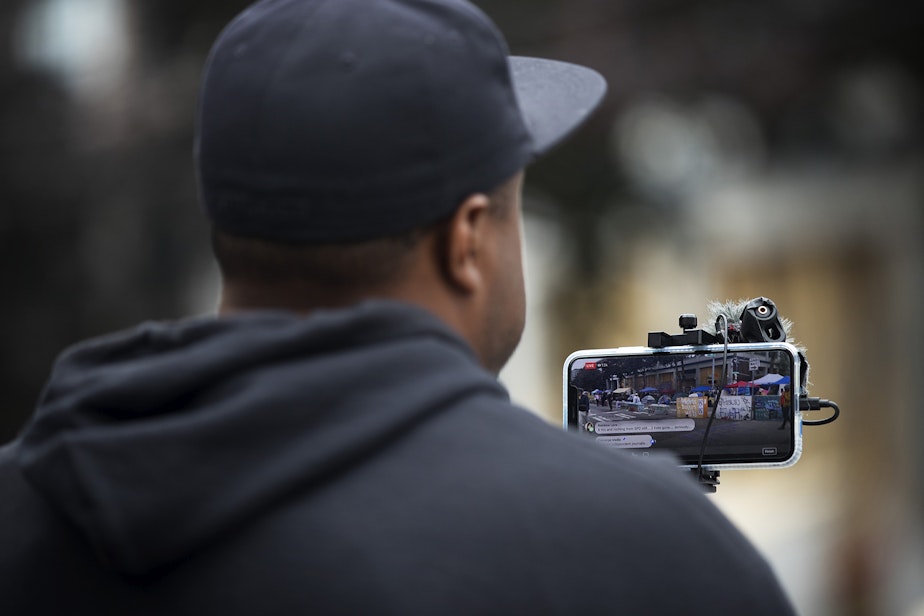
“I didn’t realize that for five years we were sitting on what very well might be the last recording that anybody has of him,” Salisbury said. It was Salisbury, too, who was one of the first reporters on the scene with a camera after Mays was shot, capturing witness interviews and the bullet-riddled Jeep.
Seattle police investigating Mays’ death never reached out to inquire about Salisbury’s footage or his experience interviewing witnesses in the aftermath of the shooting, he said. When asked to respond, Seattle Police Department Sgt. Patrick Michaud emailed, “This remains an active and ongoing investigation.”
Sponsored
It was significant to Salisbury that the depiction of Mays in the footage mirrored how his father described him — as an earnest, idealistic 16-year-old who wanted to participate in his generation’s civil rights movement.
“The narrative around Antonio is one, for the most part, it’s been pushed negatively,” Salisbury said. “To hear his voice and to hear the words that he said, it was an emotional moment for a lot of different reasons.”
Sydney Brownstone: 206-464-3225 or sbrownstone@seattletimes.com: Sydney Brownstone is an investigative reporter at The Seattle Times.
David Gutman: 206-464-2926 or dgutman@seattletimes.com: David Gutman covers local politics and King County government at The Seattle Times, reporting on how leaders and institutions impact the lives of everyday people.
Will James: wjames@kuow.org: Will James is a reporter and producer for KUOW Public Radio.
Sponsored
-
Sydney Brownstone

Reporter, Lost Patients
Sydney Brownstone is an investigative reporter at The Seattle Times. She previously covered homelessness in Seattle and was a Livingston Award finalist for her work on the podcast Outsiders. Brownstone hails from the world of alt-weeklies, where her reporting on sexual assault and sex work prompted the Washington Attorney General’s first-ever consumer protection lawsuit on behalf of sex workers.
More stories from Sydney Brownstone » -
Will James

Audio Documentary Producer
As an audio documentary producer, Will James creates deeply-reported podcasts and specials that illuminate complicated and polarizing issues in the Seattle region.
More stories from Will James »


