Washington farmworker who led union efforts talks life after ICE detention, returning to Mexico

Between the lush green mountains of Western Washington and the ones found in the northern parts of the state of Guerrero, Mexico, Alfredo Juarez Zeferino said the landscape is pretty similar.
It's the rainy season, and scattered clouds hung low in the sky as he hiked up the mountain near his new home of Santa Cruz Yucucani. Fresh mountain springs surrounded him along the trails all around him.
RELATED: WA farm labor organizer ends his deportation fight after 4 months in ICE detention
“Here, there are a lot of small little creeks, with water, very clean water, like, straight from the ground,” Juarez said. “It's just been very exciting to go to the field and go drink a lot of water straight from the ground.”
Juarez has been back in Guerrero for more than a month after deciding to end his deportation fight. He was detained by ICE in the spring, near the fields where he worked in Washington’s Skagit Valley. Juarez, who hopes to legally re-enter the U.S. one day, did not speak to the press about his months in detention until recently.
Sponsored
Juarez came to the U.S. when he was 8. In his teens, when school was out for the summer, he spent time working the Washington fields with his parents.
"I've given a lot to the community there, he said. "Not just in in this little town where I lived, but in the whole state, the U.S. economy — with my labor, with paying tax, all of this."
Almost everyone in Santa Cruz Yucucani knows someone or has family that has left for the U.S, like Juarez's family. In his case, it’s been 17 years since he’s set foot in Guerrero.
RELATED: ICE detains leader of farmworker union in northwest Washington state
These springs were where Juarez filled up while he was working on his grandfather’s plot of land, where they grow corn.
Sponsored
“My family planted [that] corn,” he said. “We're working for ourselves.”
“When these crops grow, we'll gather them, and they will be for our family,” he explained. “Now, the big difference is that we don't have a boss here, and so we take breaks whenever we want.”
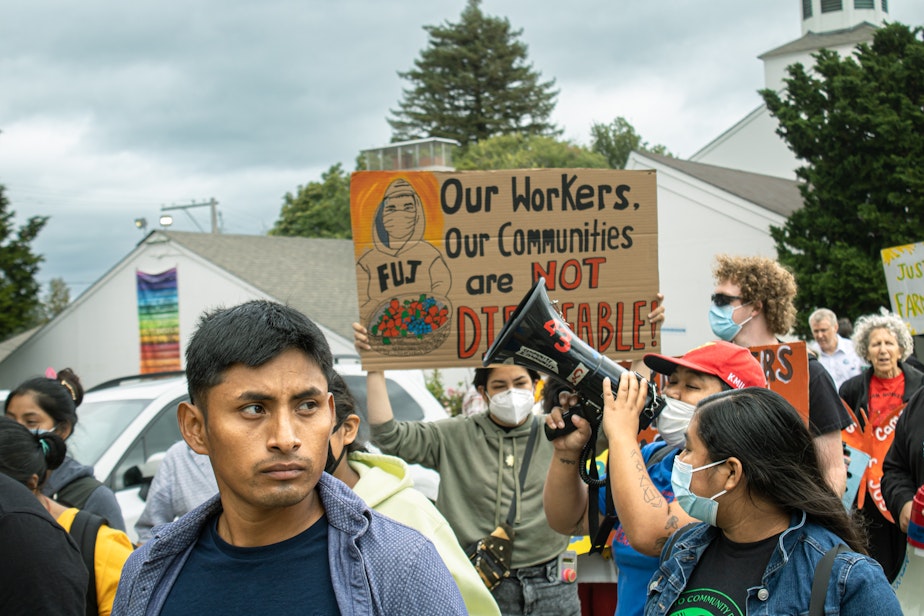
More than a decade ago, Juarez started organizing farmworkers tending the fields of Washington. They fought over the need for paid breaks, and won. That fight also led to the state’s first independent farmworker union, Familias Unidas Por La Justicia, with more than 500 members; many are Indigenous Triqui and Mixteco as well as Spanish-speaking people.
His fellow farmworker advocates believe that prominence made him a target for immigration enforcement earlier this year. Juarez didn’t find out why he was arrested by ICE until a few days after being held at the Norwest ICE Processing Center in Tacoma.
ICE argued Juarez has had a deportation order since 2018. They issued that order, but Juarez said he wasn’t notified. It was connected to a traffic stop when he was a teenager and local police handed him over to immigration officials. He later won a lawsuit in which he argued the stop was a result of racial profiling.
Sponsored
Recently, the U.S. Supreme Court issued a ruling allowing ICE to resume racial profiling practices. U.S. Citizens have also been detained.
His detention earlier this year sparked a series of protests by labor groups outside of the Tacoma detention facility.
Juarez was part of a majority of people held at the Tacoma detention center who have no criminal convictions.
RELATED: Union farmworker organizer 'Lelo' denied bond to leave Tacoma ICE lockup
During the three and a half months in detention, Juarez spent time talking with some of the 80 other men in his unit.
Sponsored
“All the other folks that were in the detention center, they were telling me that everybody, every one of them, were being told that they were going to get deported, that they weren't going to get released [despite what legal claim they may have],” Juarez said.
Many of the people he was locked up with were construction and farm workers from Washington. There were also people from as far away as Florida and Texas.
Human rights researchers have raised concerns about people arrested and transferred far from the support of their home communities — without access to a lawyer or communication with the outside world. The legal term for such detentions is “enforced disappearance.”
RELATED: Secrecy and enforced disappearances: WA human rights group sounds alarm about ICE
Some of the deportees that have passed through the facility have been sent to third countries like South Sudan or El Salvador — where Venezuelan deportees released during a prison swap alleged they were tortured.
Sponsored
Juarez often got visits from supporters and family when he was at the Tacoma facility. He was able to fundraise enough money to get legal help. But after he was denied bond, he saw a long legal fight ahead, didn’t trust the immigration court, and opted to voluntarily leave the country.
While he was in detention, his family was already settling into a new life in Mexico. His parents had lived in the U.S. since the 90s but feared family separation under the new Trump administration. They went back to Mexico in March along with seven of Juarez's younger siblings who were born in the U.S.
RELATED: 10 Americans are freed from Venezuela in a prisoner swap for migrants in El Salvador
That was just days before he was arrested. When they saw each other again, it was at an airport in Oaxaca. His family was happy to have him back.
“My mom was in tears. I know when I was detained at the detention center, it was very hard for my whole family, especially for my mom,” he said.
During some time off from his work in the fields, he takes tours of his home country, like visiting the food stalls of Oaxaca, a six-hour drive east of his home. There, cafe-style vendors sell a kind of stew called menudo, smoothies, aguas frescas, and a hallway of grills called “el Pasillo del Humo,” entertain patrons where meats are seared on a grill, a few steps away from hungry guests.
While he adjusts to this new life, working the land and exploring his new old home, he’s still pursuing a legal path to come back to the U.S. And he’s still organizing for Washington farmworkers — just from a few thousand miles away this time.
-
Gustavo Sagrero Álvarez

Race, Identity, and Immigration Reporter
Gustavo covers the intersection of race and identity for KUOW, writing stories that center voices often not catered to in typical news. He's most interested in covering how communities effect the levers of power they hold, to effect change.
More stories from Gustavo Sagrero Álvarez »


