What does UW's disappearing research money mean for Seattle's innovation economy?
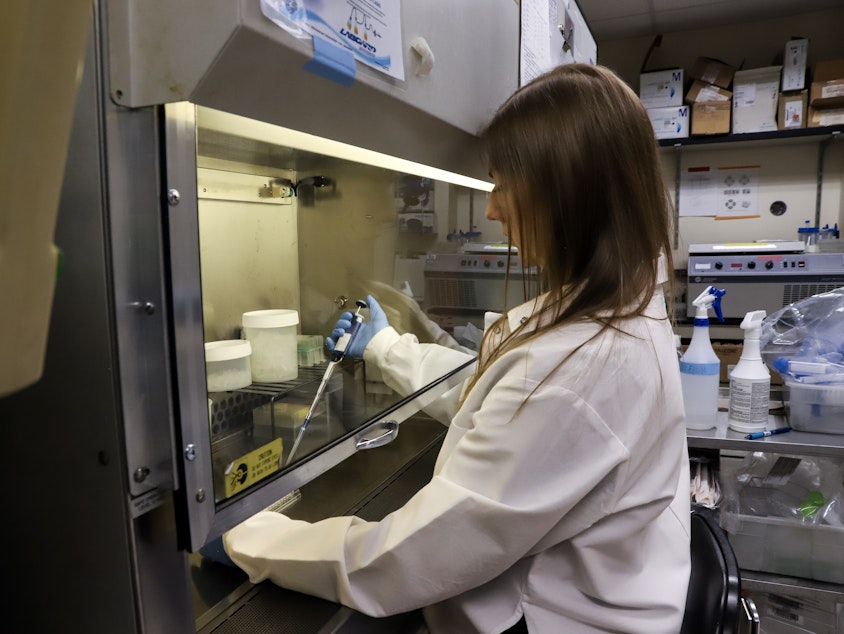

For decades, the University of Washington has received more federal research money than almost any other public university. It's a major reason the Seattle area is known for groundbreaking science in AI, aerospace, and biotech, and it's helped make the UW the city's largest employer. It's not an overstatement to call it an economic engine of the city.
Universities have won legal battles that have protected some of that funding, including some ongoing funding for existing research. But when it comes to money for new scientific experiments, the amount of money the UW actually receives has fallen off a cliff.
Consider funding for new health research, for example. Those kinds of research projects rely on money from the National Institutes of Health. The amount of award money promised to the UW has dropped by 50% year over year from fiscal year 2025 to fiscal year 2026.
But that figure can disguise another problem: The federal government is not processing grants quickly, so the amount of money the UW actually has in hand for this research has dropped 74%.
Rather listen? Check out this week's episode of Booming, KUOW's economy podcast:
Sponsored
That has big implications for the Seattle area's biotech scene.
Some of the major institutions at its core are the Institute for Protein Design and Fred Hutch, the cancer research center, both of which are associated with the University of Washington. Even the Allen Brain Institute, a research organization created by the late philanthropist Paul Allen, relies partially on federal funding.
Fred Hutch spokesperson Christina VeHeul said 70% of that institution's funding comes from the feds.
"We have experienced a slowdown in both the awarding of new grants and in the funding of newly awarded grants," she said.
Sponsored
And Fred Hutch is not alone. Nationally, the Association of American Universities found that the NIH is issuing 66% fewer grants this fiscal year than it did by this time last year, and that the value of those awards declined by 54%.
The sudden drop-off puts Seattle's innovation economy at risk.
The Institute for Protein Design grew out of decades of research, much of it federally funded, at the University of Washington. Its founder received a Nobel Prize.
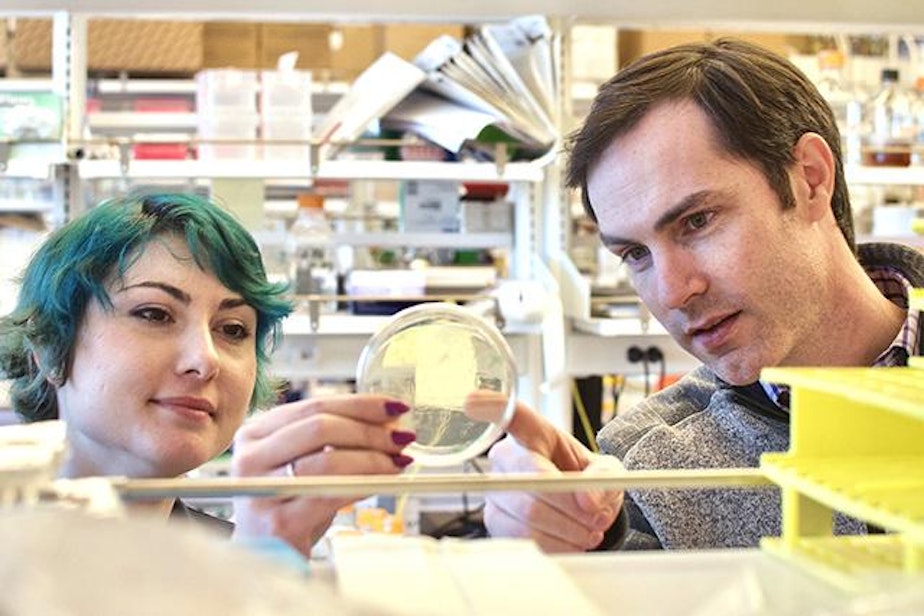
The institute uses computational tools including AI to develop new proteins not found in nature. Sometimes these proteins can be administered like a drug; other times, doctors can deliver genetic instructions so the body makes them. It remains cutting edge science to this day.
Sponsored
"That is a beautiful example of where Seattle has a comparative advantage, and that is in using data platforms to do computational biology," said MaryAnn Feldman, a professor of public policy at Arizona State University who studies the research-to-jobs pipeline. She described Seattle's biotech scene as important, but not yet big enough to stand on its own without federal funding.
Now, with the funding shortfall, she said, "You'll lose out and you'll be exporting the people that are trained at UW that are doing work at Allen Brain Institute or at Fred Hutch and they'll be going to San Francisco or Boston, because that's where the money is."
Or they'll be drawn to Canada, or Europe, which are actively courting U.S. researchers. China also has made lucrative offers for Chinese nationals doing research to move their operations there.
Back in Seattle, the Institute for Protein Design has spun out 11 startups. Some, like Icosavax, get sold to big pharmaceutical companies like Astra Zeneca. Its selling price: over $1 billion. Others, like A-Alpha Bio, continue to grow independently and hire more people (it's at 57 employees, according to Pitchbook).
But Fiona Wills, who runs the University of Washington's technology transfer arm, CoMotion, says professors and postdocs are increasingly distracted from creating new companies.
Sponsored
"What we're seeing at the moment is people saying... 'There's so many things stacked against me at the moment. I have to worry about funding my lab at the moment... which means that I can't be spending as much time thinking about who do I need to talk to, that maybe I could be creating a startup and launch a product that might have that impact,'" Wills said. "I need to figure out what my most important activity is, and it might be saving my lab."

Could private industry step in to fund what the government cannot or will not? That's what we need to happen, Feldman says.
But Wills says switching to private funding will change the kind of science that gets funded.
“ The type of research going on in a university is more cutting edge,” Wills said. It's basic, the kind of science you do without knowing exactly where it will lead.
Sponsored
“Years ago, there were research teams within companies, and some companies still have them, that were really thinking about the basic research," Wills said. "But these days they're much more focused on what's gonna become a product.”
Federal support for basic research started after World War II. There was an engineer/inventor named Vannevar Bush advising President Roosevelt and then Truman, and he wrote a report, a manifesto, really, called “Science — the Endless Frontier.”
He argued that basic research is the foundation of national security, economic growth, and a rising standard of living. That campaign eventually led to the creation of the National Science Foundation.
And it worked. The U.S. became the technological leader of the world. Experts say we’ve been enjoying the fruits of that scientific dominance for well over half a century now. But they say that era could be fading.

“Without the foundational scientific research, there is nothing to engineer and we don't develop the new products," said Roger Myers, a consultant in the aerospace scene that formerly worked at Aerojet Rocketdyne (today's L3Harris). "So there's a direct connection between the jobs of today and the future. The jobs of today are spawned by the basic research of yesterday. And the jobs of tomorrow are spawned by today's basic research.”
RELATED: How far could Trump’s NIH funding cuts set medical innovation back? By decades, UW researchers warn
Could there be a silver lining, though, to the loss of research dollars? After all, there's been criticism floating around for years that the current system encourages scientists to write papers, rather than creating jobs.
Julia Lane used to help run the National Science Foundation. Now, she studies how science is funded. Her chief complaint is that we don’t do a good job measuring whether the projects we fund, as taxpayers, are really benefiting us. Are they really all worth it.
“ I'm a boring economist," she said. "I don't get excited very easily, but I get very excited when it comes to very bad data!"
"I mean, don't get me wrong, I am a fervent supporter of science and technology and R and D,” but she says the way we fund science today is too arbitrary. It’s based on too many anecdotes, too many stories of sad scientists whose cancelled research seems important.
“The inertia in the system is so strong and it's because it's never been a big issue before, because they just kept writing checks, sending more, more money because science magically created innovation,” Lane said.
Many people in this field call that argument a distraction from the biggest problem at hand: that the U.S. is giving up its scientific prominence.
RELATED: Amid funding cuts and public health battles, NIH issues autism research grants
But Lane also brings a solution to the table. She proposes the U.S. create a nonpartisan "National Center for Data and Evidence," built on a model pioneered by some universities. She says it would add rigor to the process of choosing what research to fund. Lane says right now, we're measuring the impact of research on the economy by throwing money at science, and then looking at jobs numbers and census data to try and estimate whether that research has benefited the economy.
The big question is whether we trust science to lead us somewhere worthwhile, even when the destination is unclear, or whether we expect every research dollar to pay off quickly in useful products, jobs, and training.
But this is not an either-or situation; the two approaches can be mutually beneficial. Seattle's innovation economy has leaned on both.
Hear more stories like this one on Booming, KUOW's economy podcast:
-
Joshua McNichols

Reporter
As KUOW's Growth and Development reporter and co-host of KUOW's Booming podcast, Joshua's "growing pains" beat sits at the nexus of housing, transportation, urban planning, government and the economy. His favorite stories also include themes of history, technology, and climate change.
More stories from Joshua McNichols »


