The earthquake is coming. Is old Seattle worth saving?
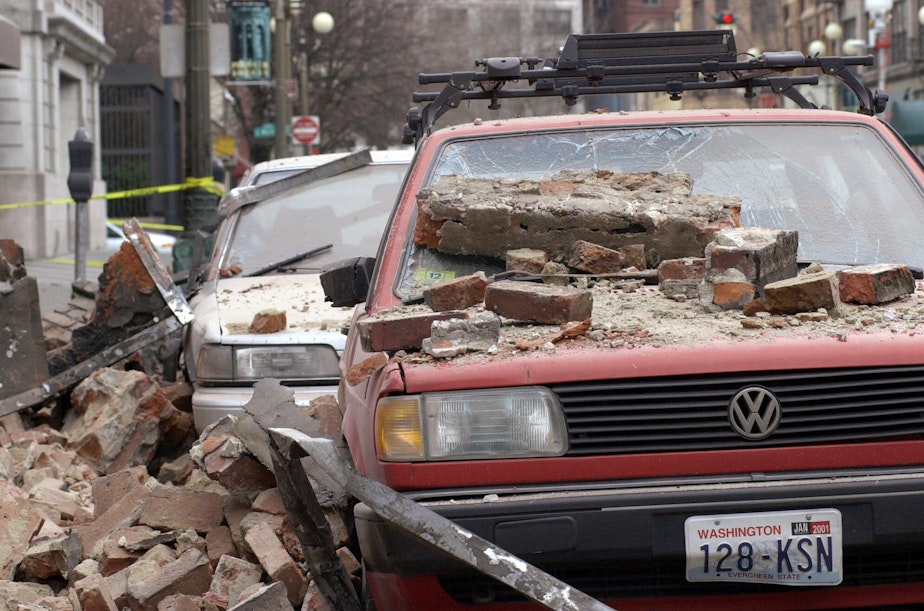

Seattle’s unreinforced brick buildings are a disaster waiting to happen — and the cash to fix them isn’t there.
It's been almost 25 years since the Nisqually earthquake. That's the last significant quake to hit Seattle.
Leslie Morishita remembers it like it was yesterday.
“We got out of there and did not dare go back inside. And we were all saying ‘Are you okay? Are you okay?'" Morishita said. "There were bricks on the sidewalks. I think a car got smooshed.’”
NOTE: This story comes from KUOW's economics podcast, "Booming."
Luckily, no one died during the Nisqually quake. But the quake did over $2 billion of damage to buildings in the region. And it offers a hint at what could happen during a much bigger earthquake.
Statistically, the region is due for one.
RELATED: An earthquake could break Seattle into several 'islands'
Since Nisqually, we’ve learned a lot about what can make buildings safer during an earthquake. There’s reason to try: These buildings draw tourists to places like Pioneer Square. Many of the charming old brick apartment buildings across the city offer affordable housing.
Sponsored

But it's going to take a lot of money — probably more than $1 billion — to make Seattle's aging brick buildings strong enough to withstand the next one. That means some owners of those old buildings may prefer to abandon or destroy them, rather than pay for expensive retrofitting.
So, is old Seattle worth saving? And is there a way to do it that won’t bankrupt the owners, or the city?
There is, but it would take both money and political will.
Sponsored
W
ashington faces around an 85% chance of facing a damaging earthquake in the next 50 years, according to the state’s top seismologist, Megan Anderson. That’s almost 9 out of 10 — not good odds.
Washington’s earthquake threats come in three flavors.
Along the coast, the Cascadia Subduction Zone could trigger up to a 9.0 “megathrust” quake and a killer tsunami. People refer to this kind of quake as “The Big One.”
Deep in the earth, intra-slab quakes like Nisqually strike when the sinking seafloor deforms before breaking apart deep within the mantle beneath volcanoes like Mount St. Helens.
Sponsored
RELATED: Hundreds of small earthquakes are hitting Mount Rainier. Geologists say they're not concerned
But the biggest danger for Seattle comes from shallow quakes on the Seattle Fault — close, violent, and amplified by soft ground. A magnitude 7.2 quake there would cause more local damage than even “The Big One,” Anderson said.
“It's a little bit hard to think about how to say this in a way that doesn't alarm people,” she said, “because it really is hard to imagine, even for a scientist. [But] it would be a really disruptive event for the United States, not just Seattle.”
Unsafe, safer and safest
In a wood house, you’re safer if the house is bolted to the foundation.
You're better off in a modern office building or even a residential skyscraper. Large buildings built to modern codes have all kinds engineering to mitigate damage from swaying and shaking.
Where you'd face the greatest risk is in an old, unreinforced brick or stone building. Seattle has a lot of them — more than a thousand. Their walls are just stacks of bricks and stones held together with mortar. Their floors rest in pockets in the walls, held there by gravity alone.
Sponsored
During a big earthquake, the walls can collapse and the floors can pancake. The fear is that this could happen when people are inside.
“We know how to fix these buildings. We know how to seismically retrofit them to reduce the probability of collapse,” said Amanda Hertzfeld.
Hertzfeld runs a program at the city that tries to encourage building owners to make their buildings earthquake-safe. She's also a major player in the city's effort to make seismic upgrades mandatory.

Seattle's Katrina
Hertzfeld said her obsession with earthquakes began as a college student, watching Hurricane Katrina on TV. During that disaster, thousands of displaced residents huddled in a sweltering hot sports stadium without enough food, water, or even toilets. In the end, Katrina resulted in the largest dislocation of residents since the Dust Bowl, according to a federal analysis.
“And my geology professor says, while this is happening, ‘An earthquake in Seattle will be our Katrina,’” she recalled. “And that's a really bold statement to make. And he says, ‘Look at all these brick buildings on campus and around the city. And my immediate reaction to that was, 'Well, why aren't we doing anything about this?' And I've been chasing the answer to that question for decades now.”
RELATED: A decade after 'The Really Big One,' this author imagines the devastation of the major quake
The city’s team on this project, which Hertzfeld now leads, started by making a database of every unreinforced masonry building in the city. Experts walked city streets or dug for evidence in archived construction documents and Google Street View. They finished their assessment in 2023.
They found more than 1,100 unreinforced brick and stone buildings. About half are offices. The other half are apartments.
Being on that list is not a good look. It opens owners up to liability, since they can't claim they didn't know their building was dangerous. And the perception of danger can lower a building’s value.
The list isn’t perfect — it contains buildings that may have had retrofits, but whose owners have not yet proven to the city that they’ve done enough to meet the new standard.
That’s how a known safe building like the seismically reinforced brick Queen Anne Elementary can appear on the list, even though it’s been reinforced twice since Nisqually.
Eventually, the school district hopes to turn in its paperwork so that parents and teachers can know they're safe.
"We have been in discussion with the city on this and working to address the matter" said Kyle Stewart, senior facilities planner for Seattle Public Schools.
But for building owners who can’t prove their building’s safety, the list gives Hertzfeld leverage to encourage them to make the necessary retrofits.
That can mean, for example, using steel to anchor floors to walls — so the walls can’t fall away, and bracing the parapets (that’s the part of the brick wall that extends above the roof) — so they don’t fall onto the sidewalk. Sometimes, it can mean nailing down new plywood to make floors more rigid.
So far, only eight out of those 1,000-plus buildings have done this work, or proven that they don’t need to.

Members of the Seattle City Council want Hertzfeld's team to make it mandatory to get off that list. But they also want to help owners pay for the work, which can get really expensive.
The council passed a non-binding resolution last year declaring this, and the mayor supports the idea. But people expected this to happen in 2020, and every year since, and it didn’t happen. The pandemic got in the way, and budget problems.
S
o, how expensive is fixing up old buildings? Take a 20,000-square-foot old brick building in Pioneer Square. If a seismic retrofit costs $150 per square foot, that’s a $3 million project. And it doesn’t go towards amenities that look good in a brochure: The work is mostly hidden in the walls and floors. You only see it pay off when it doesn’t fall down in an earthquake that may or may not happen in that building owner’s lifetime.
Everyone wants to make these buildings as safe as possible. But if the price tag is too high, some building owners might give up.
Leslie Morishita, whose nonprofit Interim Community Development Association restores buildings in the Chinatown International District, said her fear is that owners might choose to walk away.
“Our concern is that it's gonna scare owners and they're gonna sell," she said. "They're gonna be like, 'There's no way, we don't have this kind of money. We can't do it.'”
And then they might sell to someone who tears it down or retrofits it but then jacks up the rent.
Jan Johnson, who owns the Panama Hotel in the historic Chinatown International District, had another concern: abandonment. This risk is especially strong in neighborhoods with strong historic preservation protections, like Pioneer Square and the CID.

Johnson compared the situation to what happened when Seattle began requiring fire sprinkler systems in buildings.
“They made it mandatory. You had to sprinkle and a lot of people couldn't afford it, so they just shut the buildings down and they became a ghost town," she said. "A lot of buildings closed.”
She worries the same thing could happen if the city requires full seismic upgrades.
You can see the evidence confirming her fears nearby: buildings with boarded up windows above the street level.

They upper floors are closed because the cost to renovate them is too high, according to Jamie Lee of the Seattle Chinatown International District Preservation and Development Authority.
Jan Johnson said she would not sell her building, if it came to that. She believes somehow, she would find a way to fund the upgrade.
But the tough spot she faces isn’t limited to building owners. A mandatory program could also destroy affordability for residents.
West Kong Yick
Leslie Morishita pointed out a building with low-rent apartments that’s especially important to the community — for its beauty and for its connection to an old Chinese family association that built it: The West Kong Yick building.
A hundred years ago, buildings like this offered places for Chinese and other minority workers to live when they arrived as immigrants and couldn’t legally live in other parts of the city, or when workers came into town to connect with fishing boats, mining companies, timber companies, and railroad companies.

West Kong Yick is almost identical in form to the beautifully restored, East Kong Yick building that houses the Wing Luke Museum across historic Canton Alley.
But West Kong Yick is in bad shape. Only about 12 of its small apartments — mostly "single-room occupancy" rooms (SROs are basically studios with shared bathrooms) and remodeled one-bedrooms — are occupied, for safety reasons. Around 100 SRO rooms remain unused.
“It's mostly elder Chinese folks, limited English speaking, extremely low income,” Morishita said. “I mean, they live here mostly because of the rent. It's very, very low.”
The average rent in West Kong Yick is $150 per month for an SRO unit up to $650 for a one-bedroom.
That would be hard to find anywhere else in Seattle. Morishita hopes that someday, her nonprofit can help fix up or buy the building to make it safe in an earthquake. Then, she’d open up more of the apartments and keep the rents low, so those elderly folks can continue to live there — or return there, after staying in another nearby apartment during the renovation.

Her organization can do that because it’s as a nonprofit, and has different motivations and resources than for-profit developers.
Most old brick buildings won't have a non-profit like that to come to the rescue, according to Rick Mohler, who chairs the University of Washington's architecture department.
“It's really up to the building owner to decide whether or not those properties remain affordable,” Mohler said when asked about the city’s list of unreinforced masonry buildings. “And virtually all of them will need to be seismically upgraded. That's a very expensive process that will inevitably lead to increased rents in those buildings, to account for the cost of seismically upgrading them.”
Mohler wasn’t arguing against fixing them up – especially in historically important neighborhoods – but he says we shouldn’t delude ourselves into thinking this work comes without a cost.

Keeping costs down
Seattle's proposed mandatory retrofit program has been tried before, in parts of California. Amanda Hertzfeld said money came from the Federal Emergency Management Agency, but that money is less dependable now.
But even if that help comes, Seattle doesn’t have enough money to cover all the retrofits. It could cost more than $1 billion to upgrade all the buildings on the list. (Notably, that's half the cost of the damage caused during the modest Nisqually quake. It's an even better deal when you account for inflation.)
So Seattle's also doing something significant to try to lower the cost, which represents a big shift in philosophy: They’ve lowered the standards for seismic reinforcement. Under the old standards, buildings had to be strong enough to be reusable after a quake.
Under the new standards, which buildings must qualify for, owners only have to strengthen them enough that everyone can get out alive. That means after an earthquake, the buildings may be so damaged they have to be torn down, but at least nobody will have died.
This alternative path is cheaper — less than half the cost of a full retrofit.
It seems counterintuitive, that lowering the standard could save more lives. But the hope is that more building owners will choose to upgrade, even before it's required by law.
"It's better to do something than nothing," Amanda Hertzfeld said.
But that's not the only thing the city's considering.

Money out of thin air
There is a one creative solution that wouldn’t cost owners anything, but could help many of them pay for upgrades. It’s called Transfer of Development Rights, or TDRs, as people call them.
It’s an idea that’s been around for a while, but it hasn’t been used in this exact way.
If your building isn’t as tall as zoning allows, you can give up your right to build taller on your own property, and sell that unused, unbuilt height to a developer building a skyscraper elsewhere in the city so that they can build taller.
That unused airspace is valuable. Selling it brings in enough money for owners of the old building to pay for seismic upgrades. Essentially, you can sell the air above you and use the money to save your old building.
The UW's Rick Mohler calls this idea a win-win. But he says the current process for TDRs needs to be expanded and simplified, so that more people will actually use it. One of his student’s research has shown that the TDR process is cumbersome, and projects using them are rare. Plus, they’re not designed for this purpose.
N
ew buildings, built to new building codes, are generally safe. And so, saving lives may or may not mean saving an old building.
But historic preservation advocates say there are many other reasons the buildings are worth saving, especially in historic communities like the Chinatown International District.
For many families, these old buildings are the only place they can afford to stay in a community built by their ancestors who immigrated to Seattle. And if TDRs become more viable and the city finds a way to fund the retrofitting of old buildings, then maybe more of them can stay affordable to the people in their apartments.
It’s not black and white, and that's what the city is wrestling with.
This story is from KUOW's economy podcast, "Booming." Hear the episode below, or wherever you get your podcasts.
-
Joshua McNichols

Reporter
As KUOW's Growth and Development reporter and co-host of KUOW's Booming podcast, Joshua's "growing pains" beat sits at the nexus of housing, transportation, urban planning, government and the economy. His favorite stories also include themes of history, technology, and climate change.
More stories from Joshua McNichols »


