Libby Denkmann
Host, Soundside
About
Libby Denkmann has covered veterans' issues, homelessness, and local politics during her radio journalism career. She became the host of KUOW's Soundside in November 2021. Previously she was a producer, reporter, anchor, and host for stations KIRO, KFI, and KPCC in Seattle and Los Angeles. During a yearlong hiatus from journalism in 2011, she worked as a congressional staffer in Washington, D.C.. Libby was born in Seattle, grew up on the eastside, and graduated from the University of Washington. Her favorite things include soccer, video games, and her dog, Monty.
Location: Seattle
Languages: English, limited Japanese and Portuguese
Pronouns: she/her
Podcasts


Stories
-
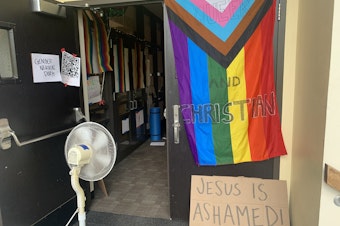
Seattle Pacific University trustees sued by students and faculty
Six members of Seattle Pacific University's Board of Trustees are facing a lawsuit regarding the university's anti-LGBTQ hiring policy. But the lawsuit doesn't follow the typical route for a case against a religious institution.
-

You think you know all the details, Sarah Marshall wants you to know you're wrong
There are probably some stories, or people, that you think you know ALL about. Writer, cultural critic, and podcast host Sarah Marshall wants you to know — you're wrong.
-

Washington judge finds Facebook violated campaign disclosure law
Washington V. Meta, brought to court by Attorney General Bob Ferguson against Meta, Facebook's parent company, concluded that Facebook ran local political advertisements throughout Washington state without properly disclosing information about who ran them. In response to Facebook's argument that the disclosure law is unconstitutional, King County Superior Court Judge Douglass North called it "very constitutional."
-

Steep terrain, high winds, and dry conditions make Bolt Creek Fire difficult to contain
The Bolt Creek Fire started early Saturday morning north of Skykomish. Tesidents who fled the path of the fire describe ash falling from the sky. Smoke blotting out the sun. Highway 2 is still closed between Gold Bar and Skykomish and an evacuation notice remains in place for Index.
-

An increase in eco-blocks signals a battle between parking and encampments
Ecology blocks are large slabs made from recycled concrete, with grooves on the top and bottom to help form retaining walls. But on city streets and sidewalks, they form a different kind of barrier: Deterring RVs and encampments, which have proliferated in Seattle during the pandemic.
-
Sound it Out: Listeners sound off on ranked choice and approval voting
One of our primary missions for Soundside is to make sure you're not just hearing US when you listen. You're hearing yourself, too. YOUR questions, YOUR thoughts - because you're our neighbors, you're the folks we make this for. This time, we're discussing the feedback you gave us two stories we did about potential changes to Seattle's voting system.
-

Soundside's summer bucket list
Schools are starting up again, Labor Day is this weekend, the sunset is inching closer to 7 pm. We can't deny it: fall is coming. So, in these waning days of Summer, the Soundside team hit the streets to record one activity we were hoping to accomplish before the rain and clouds show up. A "Summer bucket list" item that we can check off our lists.
-

For Yakima Valley residents, a ‘zombie’ sandwich represents childhood nostalgia
Back to school means the return of a lot of kids' favorite part of the day: lunchtime. And in the Yakima Valley, there's one lunchtime staple that reigns supreme: the cheese zombie. If you grew up on the west side of the state, you've probably never heard of this doughy delight.
-

Hear it again: A Puget Sound tech dystopia: Vauhini Vara's "The Immortal King Rao"
The fictional tech company at the center of the new book, “The Immortal King Rao,” is called “Coconut.” It’s a rough amalgamation of Apple and Microsoft of the 1980s and 1990s, driving a personal computer revolution, and later it morphs into a Google, Amazon and Facebook avatar in the way it gobbles up peoples’ data and monetizes human interaction.
-
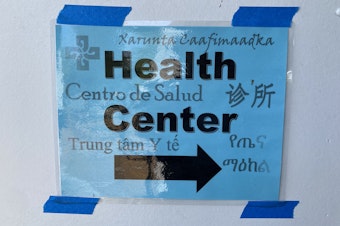
‘You have to start from scratch.’ Navigators at the World School guide students through the health-care maze
The Seattle World School in the Central District is gearing up for the new school year. Teachers are prepping for classes, lockers and classrooms are being cleaned out and readied to welcome new students. And, at the school's health clinic, two patient navigators are preparing to help students in a different way.